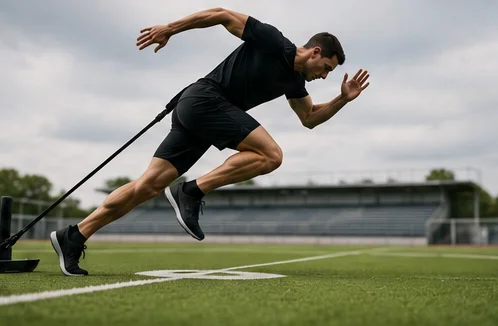
What is agility?
Agility combines changing speed or direction with responding to what you see. Planned cone drills build movement skills; reacting to a person, ball or cue helps connect those skills to sport.
Your agility training plan
-
Build the base
Strength & control
Develop leg strength, balance and comfortable running first; a physiotherapist can assess these and any injury history to tailor your starting point. Warm up with easy movement and gradual direction changes. Use a clear, non-slip area and suitable footwear.
-
Learn to brake
Slow down well
Practise slowing from an easy approach using several controlled steps. Let hips and knees bend to absorb force. Build approach speed only when you can stop and stay balanced.
-
Add direction
Cut with control
Start with predictable turns at modest speed, practising both sides. Progress speed and turn angle gradually. Get coaching rather than forcing the same foot position for every task.
-
Add the decision
React to the game
Use a simple partner cue or ball movement to choose direction. Begin with plenty of space and time, then make decisions more sport-specific without losing movement control.
A starting example
After warming up, practise 3 controlled stops, then 3 easy changes of direction each way. Rest between efforts. Add simple reaction cues only when those movements feel comfortable. Your physiotherapist can screen your strength and control first, and guide when you are ready to progress.
Quality over fatigue
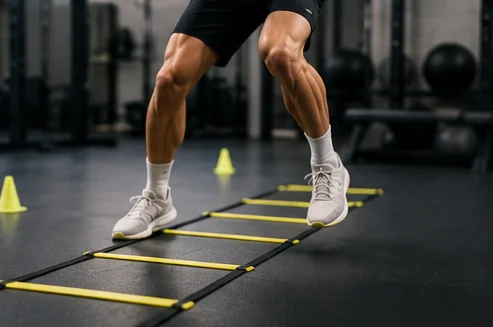
Keep drills short and take enough rest to move well. Combine agility practice with strength and sport skills. Ladder speed alone does not show that match agility has improved. If you have had an ankle, knee or hamstring injury, ask your physiotherapist to check you are ready before adding reactive work.
Train smart: when to get advice
Progress within readiness: after an ankle, knee or hip injury, obtain return-to-sport guidance before cutting at speed. A brace or a pain-free walk alone does not establish readiness.
Stop and review: repeated giving way, pain, swelling or loss of control. A locked or badly swollen knee, or inability to bear weight after a twist, needs urgent assessment.
Keep sessions appropriate: avoid crowded spaces and unpredictable contact when learning. End a drill if fatigue reduces control; build intensity across sessions rather than forcing faster turns.